History
Northwest Randolph County had seen significant settlement before the Revolutionary War. Much of the area lay within the former Granville District, where confused land titles left many early occupants without secure legal claim to the land they occupied. After independence, North Carolina began issuing its own grants, allowing settlers to formalize ownership. In the 1779 Randolph County tax list for William Millikan’s District, approximately 25 families appear to have lived in the area that later became Trinity.
Before North Carolina created a state common-school system, a few of the more prosperous residents occasionally provided winter “academies” on their farms when instructors were available. Such teachers were often itinerant and depended on students’ ability to pay. As a result, these schools seldom survived more than a few seasons.
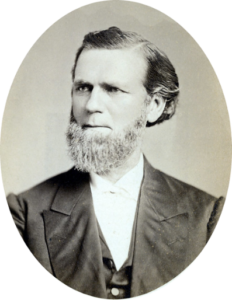
In the 1830s, scattered farm families moved toward organized community as concern for their children’s education pressed residents to create a more reliable school. Little is known about its earliest years under the tutelage of Allen Frazier. This fledgling school struggled until Brantley York, a newly ordained Methodist deacon, assumed the teaching position in 1838. A decrepit rough-log building was replaced by a hewn-log structure. With John Brown providing the site on his farm, it was known as Brown’s Schoolhouse. Today, a marker on Surrett Drive near Trinity High School commemorates its approximate location.
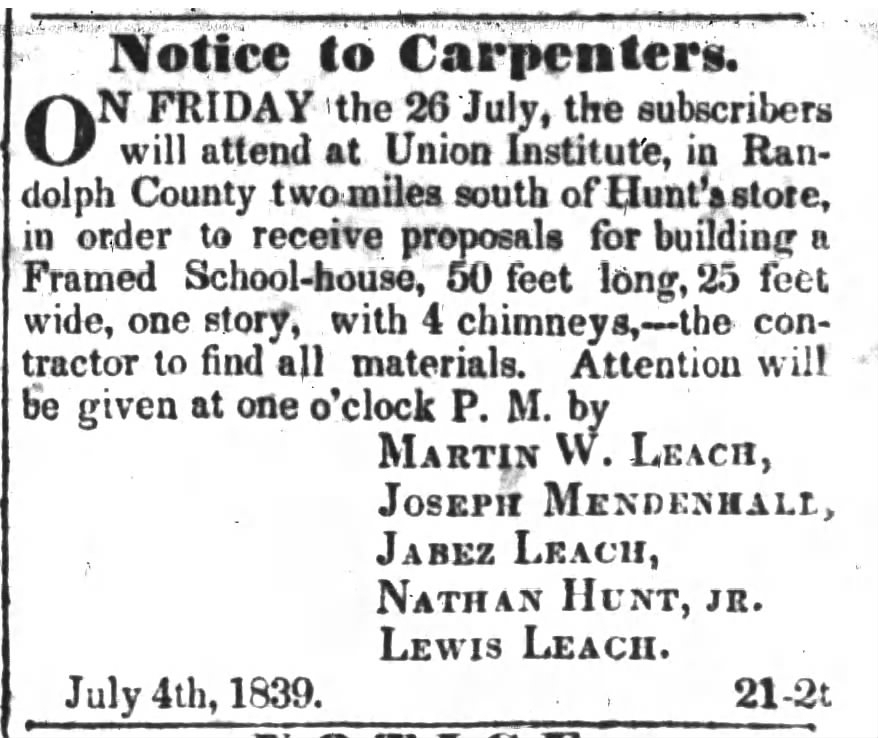
York later described these years as “truly onerous,” as he was forced to mix teaching with fundraising. Still, he pushed forward, and a five-person building committee composed of Nathan Hunt Jr., Lewis W. Leach, Jabez Leach, Martin W. Leach, and Joseph Mendenhall began planning a “modern,” frame building. A July 1839 Greensboro Patriot newspaper advertisement solicited carpenters to build a one-story frame schoolhouse, 50 by 25 feet, with four chimneys. With the frame building, the school left its log cabin origins behind and emerged as Union Institute, supported by the united effort of Quaker and Methodist leadership.
From the beginning, the Union Institute’s purpose was broad rather than elite. An 1840 newspaper advertisement announced its opening and declared as its goal, “to place within the reach of the common farmers, mechanics, and merchants an opportunity of giving their children, at least, a good business education.” The new subscription academy’s success allowed York to add an assistant instructor, a pivotal figure who would greatly impact the school’s development.

Braxton Craven entered the school’s life as a young assistant teacher in 1841 and became principal in 1842 when York decided to pursue other endeavors. Craven, believed to be York’s second cousin, was raised in the austere Quaker home of a neighbor. Though he later remembered feeling “oppressed” there, the discipline and habits he learned helped shape his later success. The school grew, and Craven did as well, obtaining honorary degrees from other, larger institutions, including the University of North Carolina around 1851. It was at this time that Craven saw the need for the school to shift direction and join the “normal,” or teacher-training movement, convincing the state legislature to recharter it to Normal College that same year. This meant students who completed the prescribed course could receive certificates allowing them to teach common schools in North Carolina without further examination. The state funding Craven expected, however, never materialized.
The need for financing was constant, and it led Craven to the North Carolina Conference of the Methodist Episcopal Church, South. In 1856, he convinced the conference to adopt Normal College. Another charter change three years later formally brought the school into a Methodist orbit, and it was renamed Trinity College at the suggestion of Charles F. Deems, reportedly in reference to Trinity College in Cambridge, England.
By 1860, the college had grown in both significance and physical presence. A large, three-story brick building dominated the campus. Trinity’s antebellum history reflected a slaveholding society in which Craven and other college leaders enslaved people. The Civil War interrupted its strongest period of growth. Students and alumni entered Confederate service with several losing their lives. Like most private schools in the South, the college struggled during Reconstruction.
Even during those difficult years, the surrounding neighborhood continued to grow to meet the housing and mercantile needs of the school, and on April 12, 1869, the North Carolina General Assembly passed a resolution chartering the town of Trinity College. The legislation established an election for a magistrate and five commissioners, declaring “The Town shall be two miles long from north to south, and one mile wide from east to west, the center of the Town to be the center of the principal College Building,” making the school the town’s organizing point. A contemporary newspaper described it as a scattered village of about 200 residents, with 150 students enrolled at the college.
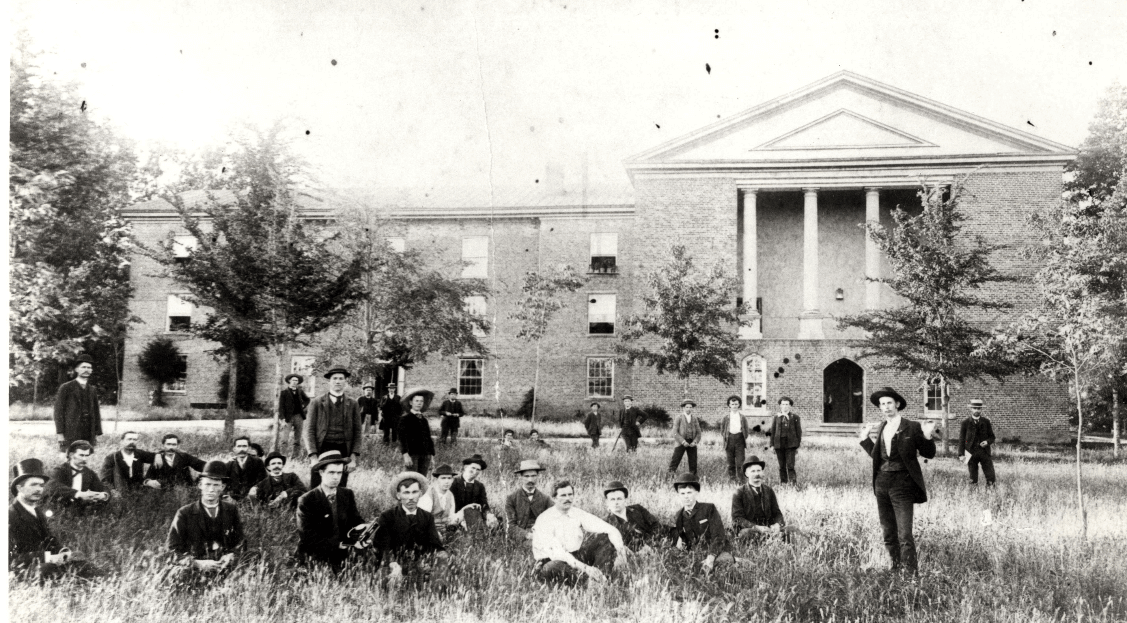
Braxton Craven continued as Trinity’s president for many years, keeping it alive during the lean post-war years, and beyond, until his death in 1882. Leadership passed through a few presidents until it settled in the hands of Doctor John F. Crowell, a Yale graduate, in 1887. Like Craven, Crowell was ambitious for the college and believed that moving the college to a more urban location would provide greater opportunities. Although a rail line had recently improved access to Trinity, Crowell believed a larger urban setting offered stronger prospects for enrollment, faculty recruitment, public visibility, and financial support. Under Crowell’s leadership, substantial funding was secured from North Carolina tobacco magnate Washington Duke and industrialist Julian S. Carr. The trustees agreed to move the school to Durham when land was provided and building commitments arranged. After 1892, the town of Trinity College no longer contained a college.
Prior to the move, Trinity College maintained a preparatory department for students not yet ready for regular college work. Because the original deed for the school property required that it be used for educational purposes, the property could not simply be sold. As part of the removal arrangement, the old campus was therefore continued as a preparatory school affiliated with Trinity College. It remained so until 1908, when Randolph County leased the recently renovated building for use as Trinity High School, part of North Carolina’s emerging system of publicly supported secondary schools. It was designated a “First Class High School,” indicating a more complete secondary curriculum, a stronger teaching staff, and sufficient preparation for college entrance. The county purchased the property in 1919 but demolished and replaced the college buildings in 1924. Columns from the original lyceum were retained, however, and reused in the auditorium of the new building. When that building was, in turn, taken down in 1981 after serving as a junior high for thirteen years, the columns were retained to create a commemorative gazebo on the site that also houses the Trinity College chapel’s bell.
In 1924, Trinity College became Duke University, renamed in honor of the family who had provided so much of its support. That same year, with the college long gone and the town’s civic function diminished, the Trinity College municipal charter was rescinded.
During the mid-1990s, it became apparent that Trinity’s identity was becoming threatened by the surrounding cities of High Point, Thomasville, and Archdale, and a movement began to preserve it through reincorporation. In 1997, residents voted to officially reestablish the city.
Sources: Nora Campbell Chaffin, Trinity College, 1839–1892: The Beginnings of Duke University; Duke University Archives; City of Trinity official history; Greensboro Patriot, July 9 and July 23, 1839; Greensboro Patriot, June 9, 1840; The Eagle, October 21, 1869; Randolph County Public Library Historic Photograph Collection.